
Why Conference Notes Die in a Drawer
Cause of Death: Your Best Business Ideas Are Buried Alive in a Conference Notebook
One-sentence summary: Most business owners never implement what they learn at conferences because they leave with too many ideas and no priorities, and cutting those ideas down to a short 90-day plan with a first step for Monday morning is what turns notes into results.
My watch said a tick over 70,000 steps.
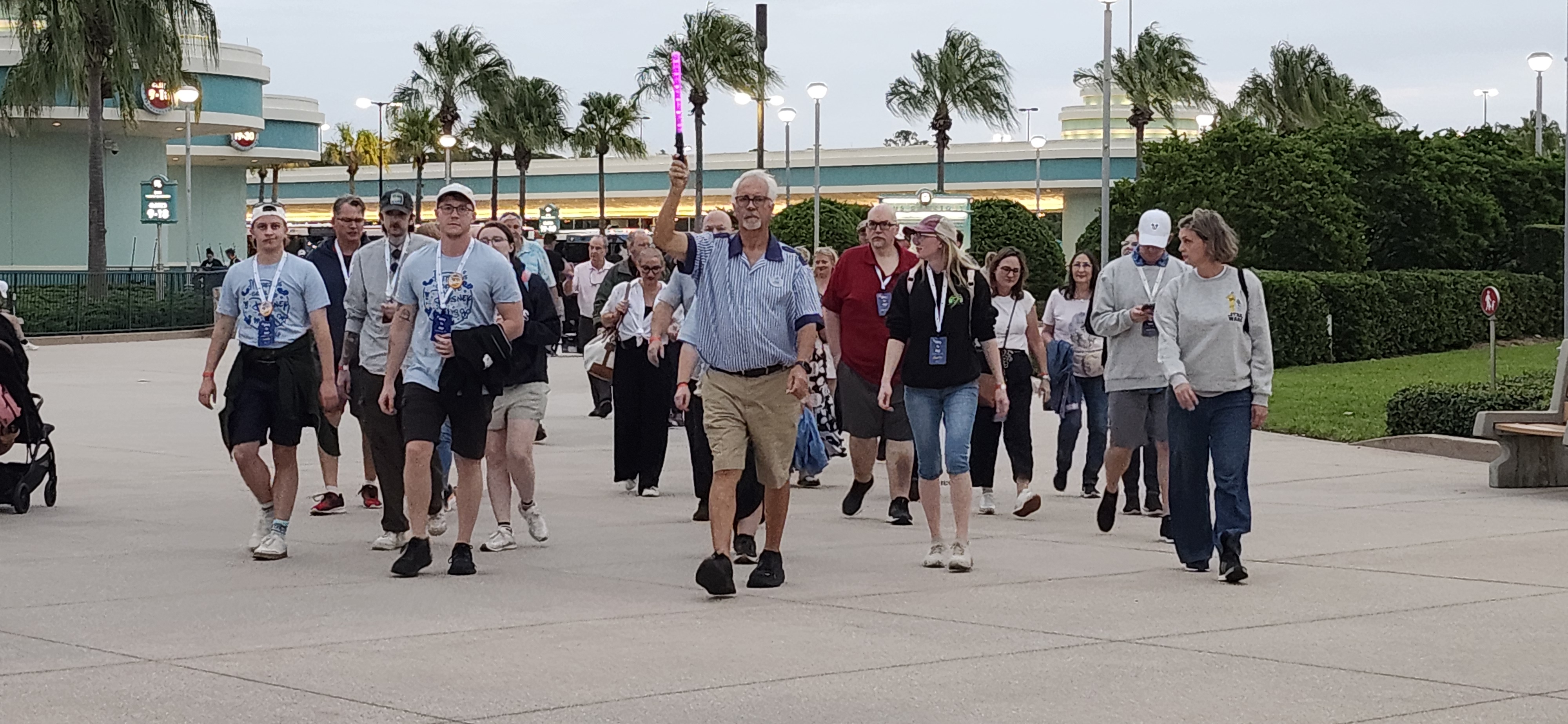
That was two and a half days at Walt Disney World, running my Making the Magic event for 46 business owners and entrepreneurs. Somewhere north of 30 miles on a pair of feet that are not 25 anymore.
And no, the attendees didn't walk all of that. On one of the days I split the group in two. I took the first half on a tour while the second half worked a scavenger hunt at EPCOT. Then I walked back, collected the second group, and did the whole tour again.
Great number. Nice bragging rights. Completely the wrong number to care about.
The number that matters showed up a few days later in a post from one of the attendees. It wasn't how far anybody walked. It was how few priorities they carried home.
Welcome back to the Crypt. Today's body has been on the slab a long time, and you've probably buried a few yourself.
How Do You Actually Implement What You Learn at a Business Conference?
You cut. Most owners leave an event with 20 or 30 good ideas and implement none of them, because nothing tells them which one comes first. The fix is to leave with a short 90-day plan: three priorities at most, each with a clear first action, a date, and the person who owns it. Everything else goes on a parking lot list you revisit after 90 days. Write the plan before you leave the room, while the ideas are still warm and somebody is there to push back on you. The first action should be something you can do Monday morning. A short list you finish beats a long list you admire.
Key Takeaway: Information doesn't build businesses. Implementation does, and implementation starts by deciding what you won't do yet.
Executive Summary
The average business conference produces enthusiasm, a stack of notes, and almost no change back at the office. The cause of death is overload. Owners come home with more ideas than hours, try a little of everything, and slide back into the old routine inside two weeks. At Making the Magic, every attendee built a focused 90-day plan before they left, and one attendee called it the favorite part of four days at Walt Disney World. That tells you something about your own customers too. The moment they remember isn't always the fireworks. It's the moment you took a weight off their shoulders.
Quick Facts
•Event: Making the Magic, October 2026, Disney's Grand Floridian Resort
•Attendees: 46 business owners and entrepreneurs
•Format: four days of classroom sessions, in-park walking tours, a backstage tour, and a hot-seat mastermind
•Output: a Customer Experience Map, written Service Standards, and a Monday Morning Plan
•My step count: a little over 70,000 in two and a half days
•Follow-through: 90 days of coaching after the event
Key Data
Data point | Value | Source |
Steps walked over 2.5 days | 70,000+ (about 30 to 35 miles) | Proprietary: my watch |
Attendees | 46 | Proprietary: event roster |
EPCOT scavenger hunt items | Cut from 30 to 10 for a two-hour window | Proprietary: event design |
Cost to acquire a new customer vs. keep one | $166 vs. $23 per year | Proprietary: my home service businesses |
Advisor fee after one hot seat | $7,000 to $50,000 | Proprietary: client result |
What Happened
Here's what four days looked like. A welcome dinner at California Grill with the fireworks going off over Magic Kingdom. Classroom mornings on the Seven Magic Keys I wrote about in my book Systematic Magic. Afternoons walking the parks so people could see the concepts working in front of them. A backstage tour of Magic Kingdom. A private viewing of Luminous. Fantasmic. Hot seats.
That's a lot of stimulation. It's exactly the kind of experience that sends people home with a notebook so full it needs its own carry-on.
And I know what happens to that notebook. I've owned one. You have too.
You get home. You've got 41 emails, two employee problems, and a customer who's been waiting on a callback since Tuesday. The notebook goes on the corner of the desk. Then into the bag. Then into a drawer where it joins the notebooks from the last three events you paid good money to attend.
That's the corpse. Brilliant ideas, buried alive under a pile of Monday.
So at Making the Magic I didn't let anybody leave with just notes. On day three, every attendee sat down and built a plan for the next 90 days. Then we put those plans in the hot seat and tore into them as a group. Too many priorities? Cut. Vague first step? Rewrite it. No date on it? Put one there.
A few days after I got home, Devin Sizemore from Aspen Earthworks posted this:
"One of my favorite parts of the event was how Vance helped everyone narrow down their ideas into a focused 90-day action plan. Instead of leaving a conference with pages of notes and an overwhelming list of things you want to accomplish, you leave with a limited number of clear priorities and actionable next steps."
Devin Sizemore, Aspen Earthworks
The post went on to say the approach creates focus, accountability, and motivation to actually implement instead of letting good ideas get buried in the everyday routine.
Think about that for a second. Dinner overlooking the Magic Kingdom fireworks. A trip backstage at the most famous theme park on the planet. And the favorite part was a worksheet.
CAUSE OF DEATH: Idea overload with no system for choosing.
The Pivot: Your Customers Remember Relief
The WOW Factor is one of the Seven Magic Keys, and most owners get it backwards. They think WOW means the expensive gesture. The fruit basket. The branded swag. The fireworks.
Sometimes it is. More often the WOW is the moment you solve a problem the customer didn't expect anyone to solve. Every conference attendee knows the post-event hangover of too many ideas and no time. Nobody expects the event to fix it. When it does, that's what they talk about.
Your business works the same way. The estate planning client who expected a 40-page document and got a one-page summary of what to do next. The homeowner who expected a technician to fix the furnace and also got a printed list of the three things that'll keep it running through February. The dental patient who expected a lecture and got a clear plan with a price on it.
Relief gets remembered. Remembered gets repeated. Repeated gets referred.
And this costs you real money when you miss it. In my home service businesses it costs $166 to land a new customer and about $23 a year to keep one I already have. Every customer who leaves your office overwhelmed is a customer who's easier to lose. Every one who leaves relieved is a customer who's easier to keep.
Now I can hear the objection. "Vance, I'm a note-taker. I'll go back through them when things slow down."
Things don't slow down. You know that. If things slowed down you wouldn't need the conference in the first place. That notebook is a promise you made to yourself in a hotel ballroom, and Monday breaks it every time.
Proof
I didn't invent this because it sounded nice on a sales page. Disney taught me that the guest experience gets engineered, and the most important part of the engineering is deciding what to leave out.
I did the same thing designing the EPCOT scavenger hunt for this event. My first draft had 30 items. Thirty. For a group that had two hours. That's a death march with a clipboard. I cut it to 10, and those 10 got done properly.
The hot seats prove it too. One financial advisor took his plan into a hot seat at a past event and walked out with a fee structure that moved from $7,000 to $50,000. One plan. One focused change. Not 30 ideas half-tried.
Past attendees have said the same thing in their own words. Shawn Perkins of Shield Financial put it simply: pick up one thing, practice it first, then work on the rest. Caleb DeLon of Paperback Expert planned to put his Customer Experience Map to work as soon as he got home. Neither of them talked about how much they learned. They talked about what they'd do first.
The 70,000 steps were my job, by the way. Two tours instead of one meant nobody stood around waiting and nobody got herded through backstage in a pack of 46. The attendees didn't need to see that effort. They needed to feel the result. Same rule applies to your 90-day plan. The work of cutting is yours so the work of doing is easy.
Systems Over Heroics
Most owners treat implementation as a willpower problem. They figure if they just want it badly enough, the ideas will get done. That's heroics, and heroics lose to Monday every single time.
A system decides for you. Here's how to tell whether you're leaving an event, a coaching call, or a planning day with a plan or with a pile.
A pile has more than three priorities. A plan has three or fewer. A pile says "improve the customer experience." A plan says "rewrite the new-client welcome email by November 14." A pile lives in your head or your notebook. A plan lives on one page, posted where you and your team see it. A pile has no owner. A plan has a name next to every line. A pile has no check-in. A plan has a date on the calendar where somebody asks you, out loud, whether it got done.
If your last conference produced a pile, don't feel bad. Feel motivated. Pull out the notebook and run it through those five tests today.
The same logic works on your customers. Whatever you hand them at the end of an appointment, a consultation, or a service call, ask whether it's a pile or a plan. A pile is friction, and I wrote about finding the friction that costs you clients in How to Make Your Business Easier to Do Business With.
Recommended Actions If This Were My Business
Monday: Find the notebook, folder, or slide deck from the last event you attended. Read it once, start to finish, and circle every idea that would change revenue, retention, or referrals.
Tuesday: Cut the circled list to three. Put the rest on a parking lot page with a date 90 days out.
Wednesday: Write one first action for each of the three. It has to be specific enough that somebody else could check whether it happened.
Thursday: Put a name and a date next to each action. Share the one-page plan with your team or your accountability partner.
Friday: Do the first action on priority number one. Today, before lunch.
FAQs
Why don't business owners implement what they learn at conferences? Too many ideas and no system for choosing between them. The owner gets home, the backlog wins, and the notes go into a drawer.
How many priorities should a 90-day plan have? Three at the most. One is fine. If you've got more than three, you haven't decided yet.
What should I do with the ideas that don't make the cut? Put them on a parking lot list and set a date to revisit it at the end of the 90 days. Nothing is lost. It's just in line.
Is a 90-day plan different from a business plan? Yes. A business plan describes where you're headed. A 90-day plan names the next few actions, who owns them, and when they're due.
How does this apply to my customers? Whatever you hand a customer at the end of an appointment should be a short, clear plan, not a stack of information. Relief is memorable, and memorable customers stay.
The Verdict
Seventy thousand steps is a fun number. It'll make a good line at the next event.
But the number I'll remember from Making the Magic is the one in that attendee's post. A limited number of clear priorities. That's what this attendee took home from four days at Walt Disney World, and that's why those ideas won't end up on the slab next to everyone else's.
Cause of death for most conference notes is overload. The cure costs nothing but the nerve to cut.
Your notebook's in a drawer somewhere right now. Go dig it up before it's too late. And if you want another autopsy on what confusion costs you, read Cause of Death: The Invisible Yellow Line Quietly Killing Your Sales.
Get Inside the Inner Circle
If you want a steady flow of ideas you can actually use, plus a monthly call where I make sure you use them, join my Inner Circle. Your first 30 days are free. And I'll send you my Disnify Your Business Toolkit as a gift. You just cover shipping.
Go to vancemorris.com/toolkit.


