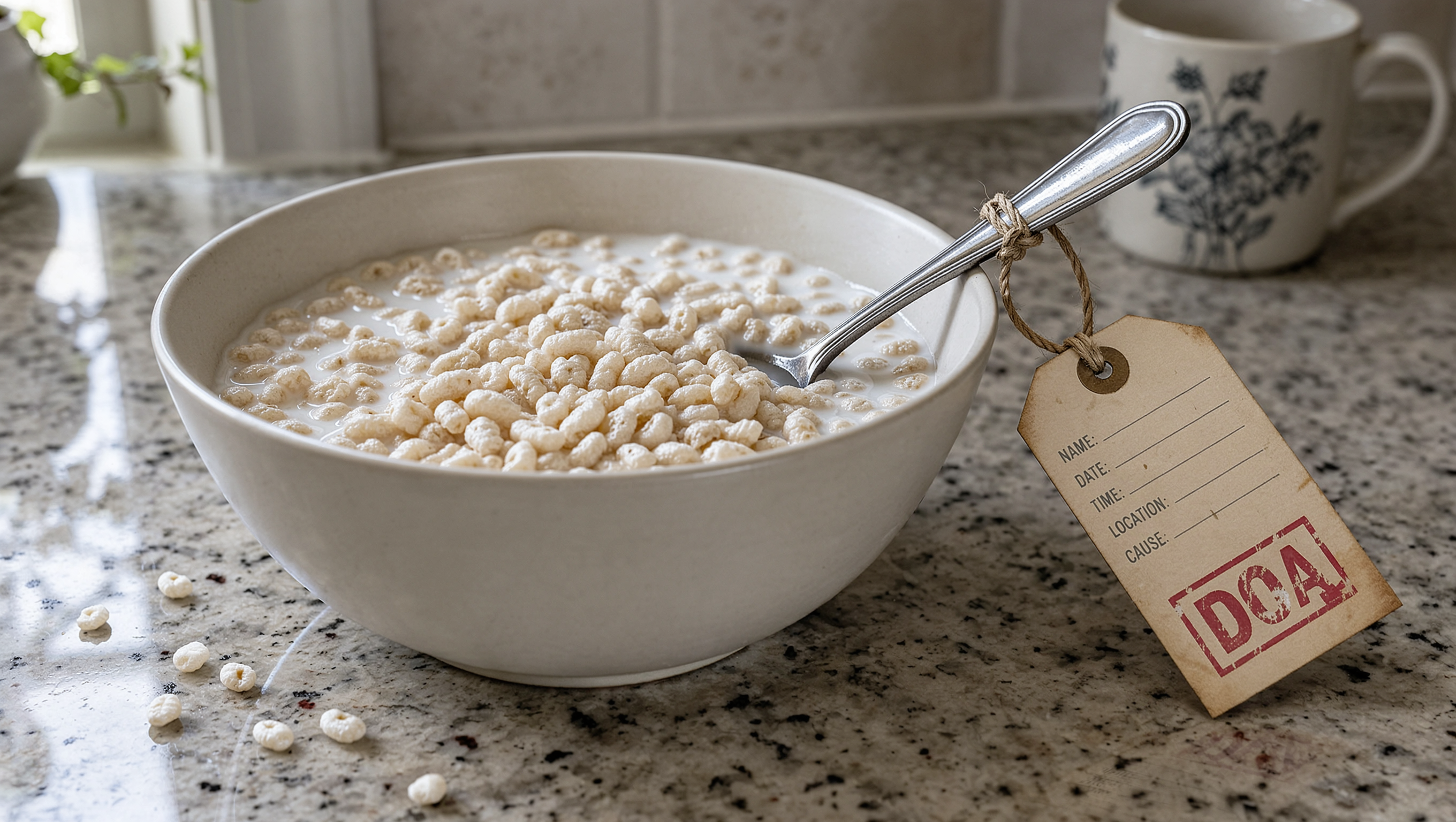
Kellogg's Strangled Snap, Crackle and Pop. Which Beloved Detail Is Your Business About to Butcher?
One-Sentence Summary: Kellogg's changed the U.K. recipe for Rice Krispies, admitted the famous Snap, Crackle and Pop got quieter, and handed every business owner a warning: before you cut or change anything, find out if it's the detail your clients love you for.
Wheel in the next body.
Three of them this time. All small, all wearing little hats. The toe tags read Snap, Crackle and Pop.
Kellogg's changed the recipe for Rice Krispies in the U.K., and the company has admitted that the most famous sound in breakfast may now be quieter. For nearly a century people have poured milk over that cereal and listened to the bowl put on a tiny percussion concert.
And now?
Psst.
Pfft.
Huh?
The cereal has laryngitis.
Please welcome the replacements: Whisper, Whimper & Wheeze. Three elderly elves who sound like they're climbing a flight of stairs after two packs of Marlboros.
Nobody buys Rice Krispies for their exciting resemblance to packing peanuts. They buy the noise. It's been printed on the box since 1932.
I'm stamping this one DOA. And before you laugh too hard at a cereal company, your business has its own Snap, Crackle and Pop. There's a decent chance somebody already has a hand on the volume knob.
Quick Answer: How Do I Cut Costs or Change My Service Without Losing Clients?
Before you cut or change anything, sort it into one of two piles. Pile one is everything the client never sees, hears, or feels. The software nobody uses. The supplier you haven't re-bid in six years. The report nobody reads. Cut there all day long. Pile two is the short list of details your clients would describe to a friend. The receptionist who knows their name. The handwritten note. The call the day after the job. That pile is your magic, and the spreadsheet doesn't get a vote on it. If something outside your control forces a change to pile two, tell your clients before they find out on their own, and put something every bit as good in its place. Kellogg's did neither.
Key Takeaway
Your clients don't stay for the reasons printed on your invoice. They stay for one or two small details that happen every single time. Find them, write them down, and guard them like the cash drawer. Don't screw with the magic.
Executive Summary
In early November 2026, Kellogg's confirmed to the BBC that it had changed the U.K. recipe for Rice Krispies and Coco Pops, replacing whole rice grains with corn flour and rice flour. The company blamed weather-damaged rice supplies and admitted the Snap, Crackle and Pop might be quieter and slower to start. Customers found out from their own cereal bowls first.
If you own a law firm, an advisory practice, a dental office, or an HVAC company, the cereal is beside the point. The small details your clients have come to expect are often the whole reason they stay, and they're the first things an efficiency push kills. This article covers how to find those details, how to protect them with a written standard, and what to do when a change gets forced on you.
Quick Facts
What changed: U.K. Rice Krispies and Coco Pops are no longer made from whole rice grains. They're made with corn flour and rice flour.
What Kellogg's admitted: the sound may be quieter and slower to start.
Kellogg's stated reason: weather has hurt the supply and quality of the rice it uses.
Who's affected: the U.K. and Ireland. Rice Krispies in the U.S. and Canada come from a separate company, WK Kellogg Co, which says its cereal is still made with real rice.
How customers found out: by eating it. The complaints hit TikTok and X before the company said a word about the sound.
Magic Key: #3, the Wow Component.
Key Data
1932: the year "Snap, Crackle and Pop" first appeared on the cereal box. External: Yahoo News Canada.
2022 and 2023: the years of extreme weather in Spain that Kellogg's says cut its rice supply. External: BBC reporting, via Yahoo Finance.
26%: increase in sales of my carpet cleaning company's mid-tier package after a gift box became part of every visit. Proprietary: Eastern Shore Carpet Cleaning.
About $5: what that gift box costs me per visit. Proprietary: Eastern Shore Carpet Cleaning.
$65,000 to $75,000: added revenue per year from that box. Proprietary: Eastern Shore Carpet Cleaning.
Under 60 minutes vs. 7.3 hours: how fast businesses answer a new prospect compared with a client of 12 months or more. Proprietary: DSNI member survey.
60% to 80%: share of defecting customers who said they were satisfied before they left. External: Frederick Reichheld.
Whisper, Whimper & Wheeze Report for Duty
Here's the autopsy.
Rice Krispies used to be made from whole grains of rice. Cook a grain of rice the right way and it fills with air. Pour milk on it, the air gets forced out, and there's your snap.
The U.K. version is now made from corn flour and rice flour. No whole grain. A lot less noise.
Customers noticed immediately. They went to TikTok and X to complain about the taste. One mother said her toddler won't touch them. Two hosts on Good Morning Britain poured milk over a bowl on live television, leaned in, and pronounced the sound dead.
Then, and only then, Kellogg's told the BBC that customers "might notice that the sound may be quieter and not as instant as before."
Not as instant. So the elves are on a delay now, like a bad satellite interview.
In fairness, Kellogg's gave a reason. The company says bad weather has wrecked the supply of the rice it uses, including two rough years in Spain. That may be completely true. And if you're reading this in the States like I am, relax. Your box is safe. Rice Krispies over here are made by a different company, and it says it's sticking with real rice.
So I can't prove this was a cost-cutting stunt. But I've sat in enough meetings to imagine how the conversation went.
Meet the New Executive Team: Shrink, Skimp & Save
"Johnson, we've got a problem with the rice."
"What's that, sir?"
"It's scarce, it's expensive, and frankly it makes too much noise."
"Good heavens. Should we also take the bubbles out of Coca-Cola and the crunch out of Doritos?"
"Put together a task force."
I can only assume the task force was led by three other elves.
Shrink, Skimp & Save.
Shrink handles product development. Skimp oversees the customer experience. And Save is the CFO, who hasn't eaten a bowl of Rice Krispies since 1987 but is absolutely delighted with the quarterly projections.
Together they took a product whose entire identity is THREE SOUNDS and turned the sound down.
That's Harley-Davidson announcing its motorcycles will now sound like electric toothbrushes. Or Disney deciding the fireworks are too loud and replacing them with a guy waving a flashlight. Or Coca-Cola declaring bubbles an unnecessary expense. "Don't worry, folks. It's still Coke. It tastes like somebody left it open overnight."
I'd bet money there's a slide somewhere that says the revised formulation maintains acceptable cereal functionality. Which is how you say "we murdered breakfast" in PowerPoint.
You Sell a Soundtrack Too
Snap, Crackle and Pop are a product promise wearing elf hats.
Grandparents heard it. Parents heard it. Kids heard it. The sound is the experience, and the experience is what people were paying for. Rice Krispies sold breakfast with a soundtrack. Now you need a hearing aid and a stethoscope to enjoy the show.
In my book Systematic Magic, this is Magic Key #3, the Wow Component: exceeding your client's expectations on a repeatable and consistent basis. Most owners hear "wow" and think of the big gesture. The free upgrade. The hero employee who drives a forgotten folder to the airport. Those are nice. But the WOW that keeps a client for 20 years is small, and it happens every single time. Milk goes in, noise comes out. For more than 90 years.
Your business has one of these. Maybe it's the receptionist who greets every client by name before they reach the desk. The warm cookie at check-in. The tech who calls when he's 20 minutes out. The handwritten thank-you note. Your clients would never list it as the reason they hired you. It's the reason they stay, and it's the story they tell at dinner.
The trouble is that on a P&L, the magic always looks like waste.
"Do we really need to send birthday cards?"
"Couldn't we drop the complimentary coffee?"
"Why are we paying somebody to hand-write notes?"
"Can't a chatbot answer the phone?"
Sure you can.
You can cut the music, the personal touches, and the little surprises until the whole operation runs as efficiently as a prison cafeteria. You'll end up with a perfectly tuned business that nobody particularly likes.
And nobody will warn you. Frederick Reichheld's research found that 60% to 80% of customers who defect said they were satisfied right before they left. Your clients won't call to report that the cookies are gone. They get a little quieter. Then a competitor calls. I wrote about that same silence in the Popeyes ketchup packet story, and it works the same way here.
"But I Have to Cut Somewhere"
I know. Margins are tight, payroll is due Friday, and I'm not telling you to run a charity. I'm a capitalist. Profit is the point.
So cut what your client never sees. Renegotiate the insurance. Kill the software subscriptions nobody's logged into since 2023. Fix the route schedule so your trucks aren't crossing the county twice a day. There's real money in the back of the house, and no client will ever miss it.
And yes, sometimes a change gets forced on you. Kellogg's says it couldn't get the rice. Fine. Your best receptionist retires. Your cookie supplier closes. A vendor discontinues the product. That's business.
What Kellogg's did next is the part I'd fire somebody over.
They changed the one thing the brand has advertised for generations, said nothing about the sound, and let customers discover it at the breakfast table. Meanwhile, according to customers quoting the new packaging online, the box brags that the cereal is now crispier with the same taste.
Give me a break.
If you have to touch the magic, you tell your clients first. You tell them why. And you replace it with something every bit as good. You don't slap a "new and improved" sticker on it and pray nobody listens closely.
A $5 Box an Accountant Would've Killed by Lunch
Years ago one of my carpet cleaning technicians walked in on a Monday morning and told me he showed up at people's homes every day empty-handed. He said a guest ought to bring something.
So he and I built a gift. It started as a bottle of my spot remover. Then a note from me. Then a box to carry it in, then a little bag of Entenmann's cookies, then a custom box with the logo on it. Six or seven months of tinkering. (The whole story is here.)
That box costs me about $5 a visit.
Put that line item in front of Shrink, Skimp & Save and it's dead before the coffee gets cold. Five bucks? Every job? For cookies?
Sales of my mid-tier package went up 26% after the box became part of every visit. That's $65,000 to $75,000 a year in added revenue. And not one other carpet cleaner in my market was doing it, so every client who got one had a story to tell: "You'll never guess what happened when the carpet cleaner showed up."
That box is my Snap, Crackle and Pop. Nobody touches it.
Now a number that's closer to home. When I surveyed my DSNI members, a new prospect got an answer in under 60 minutes. A client who'd been around 12 months or longer waited an average of 7.3 hours. Nobody held a meeting and voted to ignore loyal clients. The volume got turned down a little at a time. Same as the cereal.
Put the Magic in Writing Before Somebody "Improves" It
In most businesses the magic lives in one person's habits. Your office manager remembers the names of every client's kids because that's who she is. Wonderful. The day she retires, your Snap, Crackle and Pop retires with her, and you won't know it's gone until the phone gets quieter.
A habit can be cut by accident. A written standard has to be cut on purpose, by somebody with a name.
At Walt Disney World I did good show, bad show walkthroughs, where you walk the operation the way a guest would and look at what they'd see. Do the same thing with any cut or change before you make it. I run it through three questions. Can the client see it, hear it, taste it, or hold it? Do clients bring it up on their own, in reviews, in referrals, or at the front desk? And if I took it away, would I look like every other firm in town?
One yes means slow down. Two means you test it on real clients before anybody touches it. Three means it goes on a Do Not Touch list, in writing, with an owner, and every new hire learns it in the first week.
Everything that gets three no's is fair game. Cut it with a clear conscience and enjoy the margin.
Kellogg's would've gotten three yeses in about four seconds.
What I'd Do This Week If This Were My Business
Monday: Call ten of your best clients and ask one question: "What would you miss if I stopped doing it?" Then shut up and write down their exact words.
Tuesday: Walk your own client experience from the first phone call to the final invoice. List every detail a client can see, hear, taste, or hold.
Wednesday: Build your Do Not Touch list. Three to five items. Write each one as a standard and put one person's name next to it.
Thursday: Audit the last two years of cuts. Find one thing Shrink, Skimp & Save already killed and bring it back.
Friday: Set the rule for your team. Nobody changes a client-facing detail without testing it on real clients first. If a change gets forced on you, clients hear it from you before they notice it themselves.
FAQs
Did Kellogg's change Rice Krispies in the United States? No. The recipe change is in the U.K. and Ireland. Rice Krispies in the U.S. and Canada are made by a separate company, WK Kellogg Co, which says its cereal is made with real rice and will stay that way.
Why did Kellogg's change the Rice Krispies recipe? Kellogg's says changing weather has hurt the quality and supply of the rice it uses, so it switched from whole rice grains to corn flour and rice flour. The company admitted the sound may be quieter as a result.
What is a signature detail in a service business? It's a small, repeatable part of the experience that clients notice and talk about. A greeting by name, a handwritten note, a gift at the door. It's rarely the service itself. It's usually cheap, and it's usually the first thing cut.
How do I find out which details my clients care about? Ask them what they'd miss, and read your own reviews and referral notes for the things they mention without being asked. The details clients bring up on their own are the ones to protect.
What should I do if I'm forced to change something my clients love? Tell them before they discover it, explain the reason plainly, and replace it with something of equal value. Clients forgive a change. They don't forgive finding out on their own that you hoped they wouldn't notice.
What's one small detail worth in dollars? In my carpet cleaning company, a gift box that costs about $5 a visit raised mid-tier package sales 26% and added $65,000 to $75,000 a year in revenue.
Toe Tag: "Now With 12% Less Enjoyment!"
I wonder who's next.
Tony the Tiger gets replaced by Tony the Moderately Satisfactory? The Trix Rabbit finally gets his cereal, only to find it's been reformulated into something resembling drywall dust? Toucan Sam loses his sense of smell?
At this rate the next cereal mascot will be an accountant named Gary. He'll be on the box holding a calculator, and his slogan will be "Now With 12% Less Enjoyment!"
The Crypt's verdict stands. DOA. Kellogg's had a real problem and solved it by quietly turning down the one thing people bought the product to hear.
Somewhere in a corporate retirement home, Snap, Crackle and Pop are reminiscing about the days when breakfast made noise. And somewhere in a British kitchen, three new elves are clocking in for another disappointing morning.
Whisper.
Whimper.
Wheeze.
Rest in peace, gentlemen. You've been Disnified in reverse.
Now go find your own snap before somebody with a spreadsheet finds it first.
You won't profit unless you implement.
Vance
P.S. Get My Inner Circle Free for 30 Days
Join my Inner Circle and your first 30 days are free. You get my printed XPerience Report and a monthly coaching call where you can bring me your own Do Not Touch list and I'll tell you what's missing from it. You also get my Disnify Your Business Toolkit as a free gift. You pay the shipping. Grab it at vancemorris.com/toolkit.


