Enterprise Promises to Pick You Up. They Couldn't Even Pick Up the Phone.
Enterprise Promises to Pick You Up. They Couldn't Even Pick Up the Phone.
When a rental car broke down during a college move-in trip, Enterprise's location-level systems could not share information with each other, forcing the customer to personally relay messages between four branches and a national roadside assistance center over four days.
TL;DR / Quick Answer
Good employees deliver terrible service when the company's systems are siloed and nobody at the point of contact has the authority or the visibility to fix the problem. Enterprise Mobility operates more than 9,500 locations and books roughly $39 billion a year, and not one person I spoke with could see inventory outside their own lot, transfer a phone call, or override a data field. This is a failure of Magic Key #6, Process, from my book Systematic Magic.
Key Takeaway
Your clients don't experience your org chart. They experience the seams between your departments, and every seam you haven't documented is a place where your best employees get turned into apologists.
Executive Summary
I rented a Jeep Wagoneer to move my daughter into college in St. Petersburg, Florida. The check engine light came on outside St. Augustine and the vehicle started shaking at highway speed. Over the next four days, Enterprise refused to help me because their system had the wrong birth date on file, could not transfer me between departments, could not see vehicle inventory at any location other than the one I happened to be speaking with, attempted to re-rent me the exact vehicle they had towed away the night before, and handed me a replacement van with a slow leak and a low tire. The individual employees were not the problem. One of them, Amber at my home branch, solved in ten minutes what a national call center could not solve in three days. The company had no process for connecting her to anyone.
Quick Facts
Total elapsed time from breakdown to a workable vehicle: roughly 20 hours across two days
Number of separate Enterprise phone calls required: 9 that I can reconstruct
Number of times I had to personally relay information between two Enterprise employees: 5
Number of Enterprise employees who could transfer a call: 0
Number of Enterprise locations involved that had no inbound phone line: 1
Number of managers above branch level I was permitted to speak with: 0
Cost of the diesel exhaust fluid I had to buy and pour in myself: about $30
Key Data
Proprietary (Deliver Service Now Institute):
Chef Mickey's at Disney's Contemporary Resort: 400 seats, a 43-minute average table turn for parties of two, and over 700 pages of documented service systems, which I directed. Charles Henning, Vice President at Walt Disney World, documented in writing that I implemented and improved Disney's core service standards there.
My 4,000-call answering study across home service companies: 18 percent of calls were answered live by a human. 7 percent produced a callback. 7 percent successfully routed from an AI to a human. Do that math yourself and then go call your own office.
I have owned three home service businesses for 19 years. A GM runs all three out of one building and I spend 90 minutes a week on them, which is only possible because the process is written down.
External (verifiable third-party sources):
Enterprise Mobility, together with Enterprise Fleet Management, manages roughly 2.4 million vehicles through more than 9,500 rental locations in over 90 countries, with revenue near $39 billion (Enterprise Mobility corporate materials, 2025).
Enterprise was founded in 1957 by Jack Taylor with seven cars. Its original differentiator was that an employee would drive to the customer's home or office (Associated Press, 2016).
The "We'll Pick You Up" tagline came from an idea proposed by a local branch manager, later adopted company-wide (Enterprise Mobility corporate history).
Jack Taylor's stated founding philosophy: take care of your customers and your employees first, and the profits will follow (Enterprise Mobility corporate materials).
What Happened
The trip started well, which is how these things always begin.
I had a Jeep Wagoneer. Big, comfortable, and large enough to swallow every single thing my daughter decided was essential to her college experience, plus my luggage. I turned the drive into a small vacation. Good roads, good company, my kid in the passenger seat for what might be the last long drive like that for a while.
Then the check engine light came on somewhere south of Jacksonville and the whole vehicle started shaking hard enough that I could feel it in the steering wheel at highway speed. I pulled off in St. Augustine, still four or five hours from my daughter's school, and called roadside assistance.
The first thing they asked was whether I was safe. Good. That's a real service standard and somebody wrote it down. I said yes.
Then they needed to verify my identity.
The Birthday I Apparently Made Up
Name. Email. Then birth date. May second.
"That's not correct."
I want you to sit with that for a second. A woman I have never met, three states away, looking at a screen, informing me that I do not know when I was born.
I told her I've only ever had the one birthday. She told me that isn't what the system shows. I offered my driver's license number, which they had already scanned at the counter. I offered my Social Security number. I offered anything she wanted. No. It had to be the birth date, and the birth date had to match the field, and the field was wrong.
Oh for fuck's sake.
So I asked her what could possibly be done about this. And here is what she told me, in complete seriousness: I needed to get my birth date changed.
Not corrected. Changed. As though the error lived in me.
I asked whether Enterprise could change it, since Enterprise is the one who typed it wrong. No. I would have to call the original branch where I picked up the car. She could not do it. She could not transfer me to anyone who could do it. I would have to hang up, look up the number myself, and call them.
So that's what I did. Standing on a shoulder in Florida next to a shaking SUV with my daughter's entire dorm room in the back.
Nobody Could Transfer a Call. Not One Person. Not Once.
The guy at the original branch was perfectly nice. He said he'd fix it. I asked him to put a note in the file confirming the change, because at that point I had a feeling.
I called roadside assistance back. Whole rigmarole again. Are you safe. Yes. Birth date. May second.
"That's not correct."
I told her I had just gotten off the phone with the branch. She said she could see the note saying they changed it, but they hadn't actually changed it in the system. So the note existed, documenting a fix that had not occurred, and the note was not sufficient, and she could not act on it, and she could not call the branch herself, and she could not transfer me.
Called the branch back. Called roadside back. Somewhere in there, my birthday finally became my birthday again.
Yeehaw.
Now, roughly an hour into this, I could begin the actual conversation about the actual broken car.
"We Can Send You an Uber"
I asked for a replacement vehicle the same size as the one I'd rented, because I was in the middle of moving a human being into a dormitory.
They offered me an Uber. To a location 45 miles away. At six o'clock at night.
I said no. I said you're Enterprise. You pick people up. That is the entire premise of the company. That is on your commercials.
She said they couldn't bring me a car.
I asked whether they were sending a tow truck for the broken one. She asked why, couldn't I drive it. I reminded her that I had opened this conversation, twice, by explaining that the vehicle was not safe to drive. Fine, she said, we'll send a tow truck.
So I said the obvious thing. Have the tow truck stop at the airport, pick up my replacement, drop it to me, and take the dead one back.
"We don't do that."
Here is the part that still gets me. They absolutely do that. It's called a tow exchange. It has a name. It's a documented service. I found this out because I called my own home branch back in Maryland and the woman there said, of course we do that, it's a tow exchange, but you have to ask for it by name.
You have to know the magic words. If you don't know the magic words, the answer is no.
I called back, said "tow exchange," and three hours later a vehicle arrived.
A minivan. A small one.
They Tried to Rent Me My Own Broken Car
I called and explained that my daughter's belongings were not going to fit in a compact minivan, which the person who dispatched it would have known if anyone had read the four previous conversations. They said nothing larger was available. I asked them to check another location. They told me they can only see inventory at their own location. They cannot access inventory anywhere else in the company.
I said that sounds like an internal problem.
Went to dinner. Dealt with it in the morning.
Called a local branch. Told the guy I needed something big. He got excited. "We just had a Jeep Wagoneer 12-passenger returned last night, I can put you in that."
You already know where this is going.
I drove over. Sitting in the lot was indeed a Jeep Wagoneer. It was my Jeep Wagoneer. The one that had arrived on the back of a tow truck the night before because it was shaking itself apart on Interstate 95.
They were about to re-rent me the vehicle that had broken down under me.
I asked whether anyone in that building had stopped to wonder why a car showed up on a flatbed. Nobody had. The tow-in and the ready-line are two different systems, run by two different people, and neither one talks to the other.
A Ten-Foot Van, a Leaking Tire, and a $30 Bucket of Mystery Fluid
What they had left was a 15-passenger Mercedes Sprinter van.
Fine. I don't care. Give me the van.
"Well, where are you going with it? Sprinters are round-trip only. You can't take it to Maryland."
I have been on the phone with this company for a day and a half at this point, asking the entire time for a district manager, an area manager, anyone with a title. Nobody would put me through. Nobody would even take a message.
So I proposed it myself: I'll take the Sprinter round-trip from this location to my daughter's school and back, and then you put me in something else to drive home.
"We can probably get you a car."
Probably. I explained that "probably" is not a word you use with a man who is 900 miles from his house.
So I called Maryland again. Amber. Amber got on the phone, made calls, and got me authorized to take the Sprinter all the way home. Ten minutes. One person with initiative doing the work of an entire national dispatch operation.
Nobody mentioned it was a diesel, and diesel was running about a dollar fifty a gallon more than gas.
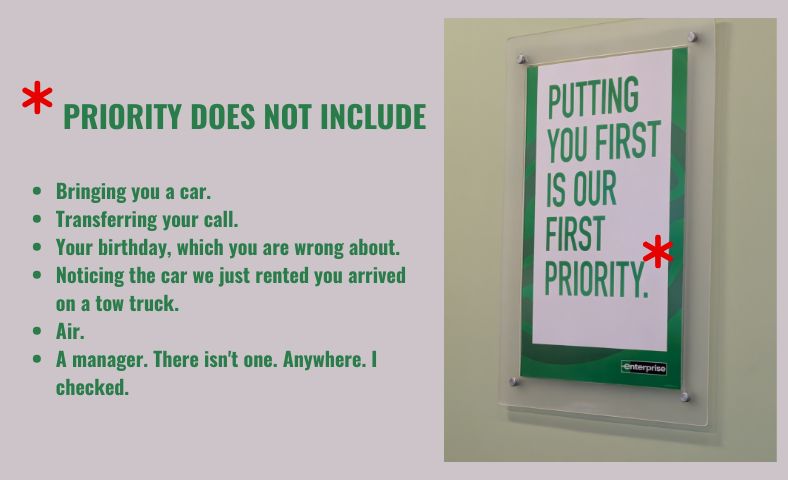
While I stood at the counter waiting, I read the poster on their wall.
"Putting you first is our first priority."
I took a picture of it. You can see it at the top of this page. I want you to keep it in your head for the next four paragraphs.
Because when I walked out to the van, the check engine light was on.

Read that again. The vehicle they gave me to replace a car that broke down with a check engine light had a check engine light.
I got there at noon because they told me the van hadn't been cleaned from the last rental yet. When I walked up, the tires were visibly low. I asked them to put air in it. The employee said, "oh, that van must have been sitting here a while, the tire got low."
So I asked her which lie she wanted to go with. Was the van just returned and dirty, or has it been sitting on this lot going flat? Pick one. I'll wait.
She filled the tire. The warning light went off. The maintenance-due warning stayed on, 5,000 miles overdue.
The van is ten feet tall and does not fit in a single parking garage in St. Petersburg. I parked it on the street. The valet told me I could leave it in the loading zone, because the ticket is $25, which is the same as valet. He was the most useful employee I encountered on the entire trip and he doesn't work for Enterprise.
Dropped my daughter off. Tire was low again. Filled it. Filled the tank with very expensive diesel. Drove 150 miles. Tire low again. Filled it.
Somewhere in South Carolina a new warning lit up: DEF critically low.

I had no idea what DEF was. My wife looked it up. Diesel exhaust fluid. If it runs out, the van either stalls or won't restart. I found a truck stop, bought a two-and-a-half-gallon jug for about thirty bucks, and poured it in myself on the shoulder of a highway in South Carolina.
I returned that van with the empty DEF jug in the back, a half-inflated tire, and a tank I did not fill.
One Last Thing
During all of this, I asked roadside assistance to transfer me to the airport location so I could verify the rental.
"They don't have a phone."
I said what.
"They have a phone. You just can't call it."
I asked how they communicate with that branch. They said they send them a message and the branch calls you back.
I asked how long that takes. They said they didn't know.
That was four days ago. Nobody has called.
Good thing I'm not still sitting on the side of the road in St. Augustine.
Why Does This Matter
Every person I spoke with was, with one exception, trying. They weren't lazy. They weren't rude, mostly. One of them hung up on me, and I'd argue she'd been set up to fail long before I called.
That's what makes this worth 3,000 words instead of a Yelp review. The employees were not the failure point. The seams between them were.
Magic Key #6 in my book Systematic Magic is Process. Here is how I described Disney's approach in that chapter: there are step-by-step procedures for every little thing that happens, from putting air in bus tires to how the parking lots fill up.
Read that again. Putting air in bus tires is a documented Disney process. Enterprise handed me a van with a low tire twice in three days, and the second time was after they'd already inflated it.
But the parallel that actually made me laugh out loud is this one. The example I used in that chapter to illustrate a broken process was Disney's "Lost Car" problem. Guests park a rental car in an ocean of identical rental cars at eight in the morning, spend twelve hours at Magic Kingdom, and stagger out sunburned with no idea whether they're in Goofy 5, Pluto 4, or Daisy 9.
The fix cost nothing. Because the lots fill in a known order, the tram drivers started logging which lot and row they were working at each point in the morning. That list got handed to the next shift of parking attendants. Guest remembers roughly when they arrived, attendant narrows it to a few rows, guest goes home.
A clipboard. A handoff between two shifts. That's it.
Enterprise could not execute a handoff between two departments in the same company on the same rental with the same customer on the phone.
"Fine, But Enterprise Is a Giant Company. My Firm Has Eleven People."
That's the objection, and it's backwards.
Enterprise didn't get siloed because it got big. It got siloed because it grew without documenting the handoffs, and then it got big, and then the undocumented handoffs got multiplied by 9,500 locations.
The company was founded in 1957 by Jack Taylor with seven cars. His whole idea, the thing that made Enterprise different from Hertz and Avis, was that an employee would drive to your house and bring you the car. "We'll Pick You Up" wasn't dreamed up in a marketing meeting. A branch manager suggested it and the company adopted it. Taylor's stated philosophy was to take care of your customers and your employees first and let the profits follow.
Seventy years later, their roadside assistance told me they don't bring cars to people.
The rot didn't start at 9,500 locations. It started at two, the first time somebody at location one needed something from location two and worked it out with a phone call instead of writing down how it should work. That informal fix felt like good service. It was actually a load-bearing wall made of one person's memory.
You have eleven people. You have handoffs right now that only work because Denise knows to walk down the hall. When Denise retires, your clients will find out.
How Professional Service Owners Are Likely to Use This
Take the piece of this that stings: the tow exchange.
The service I needed existed. Enterprise offers it. It has a name and a procedure and presumably a line item somewhere. I could not access it because the person answering the phone either didn't know it existed or didn't know I qualified, and the only way I got it was by cold-calling a different branch, learning the internal terminology, calling back, and using their own vocabulary on them.
I had to know Enterprise's internal jargon to receive Enterprise's own service.
Now go look at your firm.
The estate attorney who will absolutely restructure a trust for a client mid-engagement, but only if the client thinks to ask, because it isn't in the engagement letter and the paralegal doesn't know to offer it.
The financial advisor whose firm does 529 planning, elder care coordination, and business succession work, and whose client of nine years just hired somebody else for the succession piece because nobody ever told him.
The accountant whose clients call in March about something that should have been handled in September, because the September conversation isn't on anybody's calendar.
Every one of those is a tow exchange. The capability exists. The process to surface it doesn't. So the client either stumbles into it or leaves.
Here's my proof from the other side of the ledger. When I ran Chef Mickey's, I had to move Mickey Mouse through 400 seats while the average party of two sat for 43 minutes. That is a brutal constraint. You can't have Mickey sprinting past a seven-year-old who's been talking about this dinner for a year.
I didn't solve it with a motivational meeting. I put every stakeholder in one room. Chefs, servers, reservation agents, housekeepers, character managers, interior designers, the music director, bus boys, dishwashers, concierge. Each one designed their piece of the sequence. The bus boys built pre-loaded table reset kits. The music director picked tempos that moved people. The designers built furniture that could be moved and cleaned fast and still looked like Disney. The character managers laid out the table geography so Mickey's path never crossed itself. Then I rehearsed it. Adjusted. Rehearsed again.
The documentation came out over 700 pages. Chef Mickey's was the number one rated character dining experience in the entire Walt Disney Company for the three-plus years I ran it, with the highest reservation count and the highest revenue of any Disney character restaurant.
Nobody in that room reported to the same boss. That was the entire point.
And that's exactly what Enterprise never did. Their roadside assistance center, their branch network, and their tow vendors have never been in the same room. So when a customer's problem crosses all three, the customer becomes the integration layer.
I don't need 700 pages for a carpet cleaning company. Neither do you for a law practice. But I do have the process written down, which is the only reason a GM can run three businesses out of one building while I spend 90 minutes a week on all of it. Nineteen years. The systems are the asset. Everything else is a truck.
Strategic Implications
Your brand promise is a liability until it's a documented procedure. "We'll Pick You Up" is a beautiful promise that a call center employee told me they don't do. Every promise on your website is either backed by a written sequence with an owner and a trigger, or it's a lie you're paying to advertise.
The client is the only person who sees the whole journey. Nobody inside Enterprise experienced my four days. Each person experienced a nine-minute slice. That's true in your firm too, which is why nobody internally has ever noticed the thing your clients complain about most.
Undocumented capability is the same as no capability. If the client has to know your internal terminology to access your service, you don't offer that service. You offer a scavenger hunt.
When you don't empower people, you don't get compliance, you get heroes and quitters. Amber solved it in ten minutes. Somebody else hung up on me. Same company, same policies, same pay grade. That variance is the tell.
Recovery failures cost more than the original failure. The broken Wagoneer was bad luck. Everything after it was design. I will never rent from them again, and it has nothing to do with the check engine light.
Enterprise vs. Disney: Same Moment, Different Process
The Moment What Enterprise Did What Disney Does The Cost of the Gap Data conflict in the file Told the customer his birthday was wrong and to go get it changed Employee resolves at point of contact; guest is never the courier 3 calls, 1 hour, before the real issue was even discussed Handoff between units No transfer capability; customer relays messages manually Tram drivers log lot and row, list is handed to the next shift 5 manual relays across 4 days Inventory visibility Each location sees only its own lot Central park operations sees all lots, all trams, all capacity Wrong-sized vehicle dispatched twice A returned vehicle Towed-in car put back on the rent line Off-stage and on-stage are physically and procedurally separated Nearly re-rented the customer his own broken car Equipment readiness Low tire delivered to customer, twice Documented process for putting air in bus tires 4 roadside stops on a 900-mile drive Escalation Zero access to any manager above branch level Every cast member trained on recovery, empowered to resolve on the spot Customer permanently lost
How to Tell If This Applies to You
Run these six. If you answer honestly and get two or more yeses, you have Enterprise's disease at a smaller scale.
Can a client's issue move between two of your people without the client repeating themselves?
Does a client need to know a specific phrase or internal term to get a service you already offer?
If your longest-tenured employee left on Friday, would something break on Monday that isn't written down anywhere?
Has a client ever told you about a capability of your own firm that they discovered from someone else?
When something goes wrong, does the client have to reach you personally to get it fixed?
Can your front line spend money or make a decision to fix a problem without approval?
Number five is the one that gets owners. If you're the escalation path, you don't have a process. You have a bottleneck with your name on it.
Recommended Actions If This Were My Firm
This week: call your own office. Not from your cell. Use a number nobody recognizes and present a mildly complicated problem. Time it. Count the transfers. Note whether you got a human, a callback, or nothing. In my 4,000-call study across home service companies, 18 percent of calls reached a live human, 7 percent produced a callback, and 7 percent successfully routed from an AI to a person. You will not enjoy your own results.
This week: write down your tow exchange. One page. Every service you offer that a client would have to know to ask for. Then decide who proactively offers each one, and when. That list is worth more than your next marketing campaign, because you already paid for the capability.
Next 30 days: map one handoff end to end. Pick the one that generates the most client friction. Intake to engagement. Sale to fulfillment. Whatever yours is. Write every step, name the owner of each, and identify what information has to travel with the client. Then find the step where the client currently does the carrying, and take it off them.
Next 30 days: set a dollar figure and hand it out. Pick a number your front line can spend to fix a problem without asking you. Small is fine. What matters is that the answer to "can you help me" stops being "let me check."
Next 90 days: put your stakeholders in one room. Everybody who touches a client, regardless of who they report to. Have each one design their piece of the sequence, the way my chefs and bus boys and character managers did. You will discover things about your own business that will make you physically uncomfortable. That discomfort is the whole return on the meeting.
If you want to watch this done at scale rather than read about it, I'm running Making the Magic October 25 through 28 at Disney's Grand Floridian. Thirty people, no more. Three days of walking the operation with someone who ran it, then building your own sequences on the spot. Details at deliverservicenow.com/mtm26.
FAQs
Why do good employees deliver bad customer service? Because service quality is produced by the system, not by individual effort. When employees lack visibility into other departments, authority to make decisions, and a documented handoff procedure, even motivated people can only apologize. At Enterprise, the same policies produced one employee who solved my problem in ten minutes and another who hung up. The variance came from the process, not the people.
What is a siloed system in customer service? A siloed system is one where each department or location can only see and act on its own data. Enterprise's branch employees could not view inventory at other locations, their roadside assistance center could not edit a customer record, and no department could transfer a call to another. The customer becomes the only entity with a complete view of their own problem, which means the customer does the integration work the company should be doing.
How much does a broken internal process cost a business? More than the original failure. The mechanical breakdown of my rental was ordinary bad luck and would have cost Enterprise one apology. The process failures that followed cost them a customer for life, plus every person who reads this. Recovery is where retention is won or lost, and recovery is entirely a function of documented process and frontline authority.
What is Magic Key #6 in Systematic Magic? Magic Key #6 is Process. It covers the step-by-step procedures required to deliver a consistent experience at scale, and specifically the choke points where handoffs between people, shifts, or departments break down. Disney documents processes down to the level of putting air in bus tires. Most businesses document nothing and rely on individual memory.
How do I know if my business has a handoff problem? Ask whether a client's issue can move between two of your employees without the client repeating themselves. If the client has to re-explain, carry information, or know your internal terminology to get service, you have a handoff problem. The test is not whether your people are good. It's whether your process survives them being unavailable.
Should a small professional services firm document processes like Disney does? Not at Disney's volume. My Chef Mickey's documentation ran over 700 pages because I was moving 400 guests and a costumed character through a 43-minute window. A law practice or advisory firm may need ten pages. What matters is that the handoffs are written, owned, and triggered by something other than someone remembering.
Nobody at Enterprise Had a Bad Day. The Company Did.
I keep coming back to the branch with no phone.
They have a phone. I just can't call it. To reach them, another Enterprise employee has to send them a message, and then they call me, on a timeline nobody can estimate, which so far is longer than four days.
Somebody built that. Somebody sat in a meeting and decided that the branch's productivity mattered more than a customer's ability to reach them, and nobody in the room asked what happens to the guy on the shoulder of I-95 with his kid's dorm room in the back.
That decision was probably correct on a spreadsheet.
Jack Taylor started this company because he thought somebody should drive the car to you. Seventy years, 9,500 locations, and $39 billion later, a woman in a call center told me they don't do that.
Go find the promise on your own website that nobody in your building knows how to keep.
I'll be at the Grand Floridian October 25 through 28 with thirty business owners, tearing apart exactly this. deliverservicenow.com/mtm26.
Vance Morris Deliver Service Now Institute


