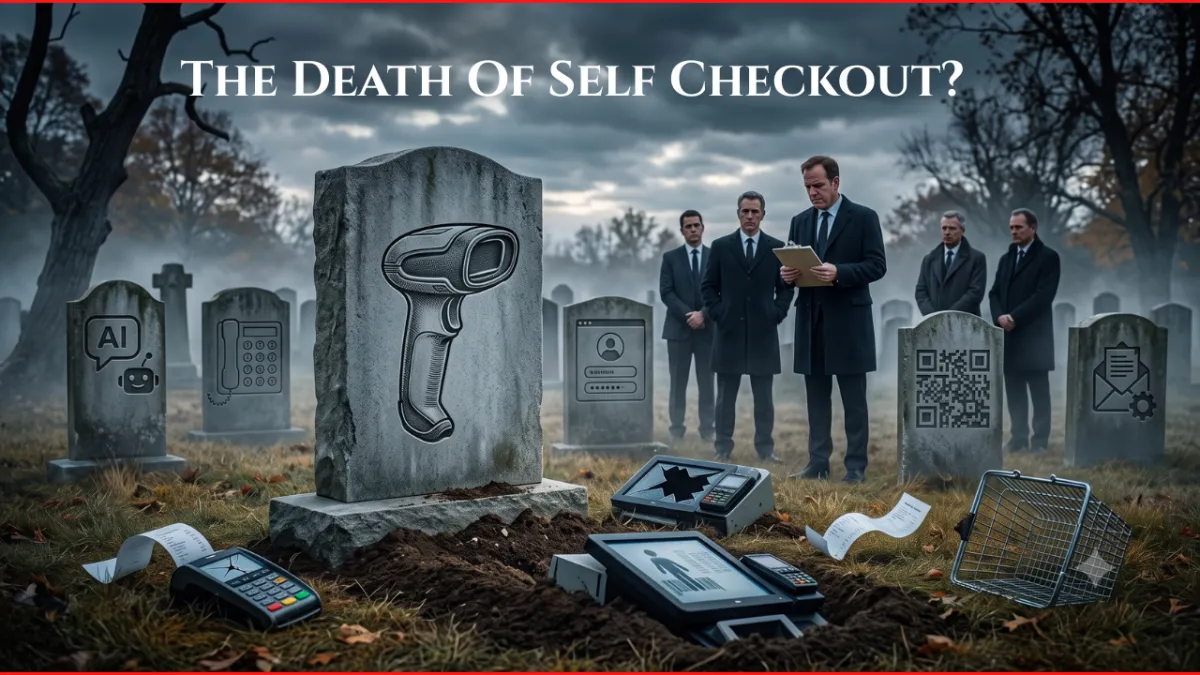
Walmart Quietly Fired the Robots. What That Expensive Retreat Reveals About Customer Loyalty
Walmart Is Yanking Out Self-Checkout. What That Expensive Retreat Reveals About Why Your Best Customers Quietly Disappear
One-sentence summary: Walmart, Target, and Dollar General are removing self-checkout machines because automating the human moment at the register quietly eroded customer loyalty, invited theft, and cost more than the labor it was supposed to save.
TL;DR / Quick Answer
The biggest retailers on earth spent a decade replacing cashiers with machines to cut labor. Now they are ripping the machines back out. Not because the tech broke. Because they automated the one moment that actually built loyalty, and their customers quietly walked. If you have swapped a human interaction for a "convenient" system somewhere in your business, this is your warning shot.
Key Takeaway
You do not lose customers because something went wrong. You lose them because nothing memorable ever went right. When you strip the human moment out of your service to save a few bucks, you are not cutting cost. You are cutting the reason people come back.
Executive Summary
In March 2026, a Walmart in South Philadelphia quietly pulled out its self-checkout kiosks and put humans back behind the registers. It was not a one-off. Walmart announced more than 650 store remodels, and Target, Dollar General, and Five Below have all been scaling back or killing self-checkout entirely. The public reason is theft. The deeper reason, backed by a Drexel study, is that customers forced to do their own checkout are measurably less loyal. Retailers gambled that speed and efficiency could replace human service. They lost. This is Service Mission, the third of my Seven Magic Keys, playing out on a national stage. Every one of these companies forgot the one thing they actually exist to do, and the market handed them the invoice.
Quick Facts
Walmart, Target, Dollar General, and Five Below are all removing or restricting self-checkout in 2026.
The stated driver is theft. The quieter driver is customer loyalty and satisfaction.
Lawmakers in New York City are now trying to legislate self-checkout limits.
A university study found regular-checkout customers stay more loyal than self-checkout customers.
The whole mess is a Service Mission failure, dressed up as a technology problem.
Key Data
Shrewsbury, Missouri Walmart: police calls dropped from 509 (January through May 2024) to 183 in the same window of 2025 after self-checkout was removed. Arrests fell from 108 to 49. (External, Shrewsbury PD reporting)
Walmart announced more than 650 store remodels in April 2026. (External, Walmart)
Dollar General stripped self-checkout from roughly 12,000 stores in 2024 and eliminated it entirely from its 300 highest-theft locations. (External, Dollar General)
A December 2025 LendingTree survey found 69% of self-checkout users believe the tech makes theft easier, and 27% admitted walking out with unscanned items on purpose. (External, LendingTree)
A 2024 Drexel study led by Professor Yanliu Huang found customers are more likely to stay loyal to a store when they use a staffed lane instead of self-checkout. (External, Drexel University)
I have owned three home service businesses for 19 years and now spend 90 minutes a week on them, because I built the human moments into systems instead of ripping them out. (Proprietary, my own companies)
I ran Disney operations for a decade, where 75,000-plus cast members deliver the same service mission every minute of every day. (Proprietary, my Disney tenure)
What Happened
Something disappeared from a Walmart in South Philadelphia this past March.
The self-checkout machines were gone. In their place, actual human beings. Behind actual registers. Looking customers in the eye like it was 1994.
For ten years the story in American retail went the other direction. Self-checkout multiplied across every big box store in the country. It got sold to shoppers as faster and more convenient, and it got sold to Wall Street as a clean way to slash the payroll. Walmart leaned into it harder than almost anybody. Then, without a press conference or a mea culpa, it started quietly hauling the machines out. Philly was just the one that made the news.
And Walmart is not alone. Target slapped a ten-item limit on its self-checkout lanes. Dollar General tore self-checkout out of about 12,000 stores and killed it completely in the 300 locations that were bleeding the most inventory. Five Below is phasing the whole thing out. Even the politicians got involved. A New York City council member is trying to pass a law limiting self-checkout to 15 items and forcing stores to staff at least one employee for every three machines.
Now, the reason everybody wants to talk about is theft. And the theft numbers are ugly. A LendingTree survey in December found that 69% of people think self-checkout makes stealing easier, and better than a quarter of them admitted they have walked out with unscanned items on purpose. No shit. You handed the fox the keys to the henhouse and act surprised there are feathers everywhere.
But here is the part nobody on CNBC wants to sit with. There is a Walmart in Shrewsbury, Missouri where the police call log tells the whole story. From January through May of 2024, cops responded to that store 509 times. Same stretch the next year, after self-checkout came out? 183. Arrests dropped from 108 to 49. The local police chief pinned it directly on pulling the machines.
Half a business's worth of chaos, gone, because they put a person back in the room.
Why This Matters (And Why "But It Saves Money" Is a Lie)
Theft is the headline. It is not the lesson.
The lesson is buried in a study out of Drexel University. Researchers found that when you force a customer to ring up their own order, their satisfaction drops and their loyalty goes with it. People feel entitled to be served. Make them do the labor, and something quietly curdles. They do not file a complaint. They do not leave a one-star review. They just start choosing the other store.
That is the scariest kind of customer loss there is. The silent kind. No confrontation, no feedback, no warning. One day the number is just lower and nobody can tell you why. (I mapped exactly where that silent loss springs a leak, and how to catch the retention violation before the client walks, in a separate piece.)
This is a Service Mission failure. And Service Mission is Magic Key number three in my book for a reason.
Your Service Mission, what I call your service manifesto, is not your mission statement. It is not the laminated garbage on the break room wall that nobody has read since orientation. Your manifesto is your actual product. It is what you are really selling underneath the thing on the invoice. Disney's manifesto is to create happiness. That is why a cast member sweeping Main Street will stop, drop the broom, and offer to take your family photo so nobody gets left out of the picture. Sweeping the street is his job. Creating happiness is his mission. Everybody at that company knows the difference.
Every retailer that bet the farm on self-checkout answered the question "what business are we in?" with "moving boxes past a scanner as cheaply as possible." So they built exactly that. A box-moving machine. And it turns out nobody feels any loyalty to a box-moving machine.
Now, before you dismiss this as a big-dumb-corporation problem that has nothing to do with your law firm or your HVAC company. Let's be honest about where your own version of the self-checkout machine is hiding. The AI phone tree that makes a prospect press seven buttons to reach a human who never picks up. The "portal" you make clients log into instead of talking to them. The generic drip email with your logo on it that any of your competitors could have sent. Every one of those is you handing your customer a scanner and telling them to ring themselves up.
You did not save money. You trained your best customer to feel like unpaid labor, and then you wondered why the referrals dried up.
How to Use This In Your Business This Week
Here is the good news, and it is the whole reason I do what I do.
The bar is on the floor. Your competitors have spent a decade automating the humanity out of their businesses right alongside Walmart. Which means the human moment is now the rarest thing in your entire market. It costs almost nothing and it is worth a fortune, precisely because everybody else quit doing it.
I know this because I live it. I own a carpet cleaning company, an oriental rug washing facility (the only one that hand washes rugs within 100 miles, because I refuse to feed a rug to a machine), and a mold remediation company. Nineteen years. Three businesses. And I spend 90 minutes a week on all of them combined, because I did not automate the human moments away. I systematized them so they happen every single time without me standing over anybody. The tech confirmation calls, the flowers when a technician runs late, the thank-you that lands after the job. Those are not fluff. Those are the manifesto, running on rails.
Disney gets 75,000 people to do this every minute of every day. You have to get it out of, what, six? Eight? If Disney can hold the line at that scale, your excuse just died.
Strategic Implications
The company with the clearest Service Mission wins the loyalty war, not the one with the slickest tech. It is how Disney turned its customers into citizens.
Silent attrition, the customer who leaves without complaining, is the most expensive and least tracked loss in your business.
Automation applied to the wrong moment does not cut cost. It cuts retention, which is far more expensive to replace.
The rarer human service becomes across your market, the more pricing power it hands the one business that still delivers it. It is the same reason Disney has never apologized for its prices.
Efficiency is a fine servant and a terrible master. The moment it outranks your mission, you are Walmart in 2019, and the bill is coming.
Recommended Actions If This Were My Business
This week: Write your one-sentence Service Manifesto. Not a mission statement. The real answer to "what am I actually selling?" A financial advisor is not selling portfolios. He is selling the ability to sleep at night. Name yours in a single sentence a new hire could memorize.
This week: Find your self-checkout machine. Walk your customer's path from first contact to invoice and pinpoint the one place you swapped a human moment for a system to save yourself effort. You already know where it is.
This month: Put one human moment back. Manned, deliberate, unignorable. A real confirmation call. A handwritten note. A person who answers the phone. The single highest-leverage spot to plant it is the 60 seconds right after someone says yes to you. I call that Moment Zero, and it is where retention is won or lost. Watch what it does.
This quarter: Systematize it so it survives you. A human moment that depends on you remembering to do it is a hobby. A human moment that runs on a system is an asset. That is the entire difference between a business you own and a job you are trapped in.
FAQs
Why are stores removing self-checkout in 2026? Publicly, theft. Self-checkout drove up shrink and, in some stores, crime. Underneath that, customer loyalty. Research shows shoppers forced to ring themselves up are less satisfied and less likely to return, so the "labor savings" quietly cost retailers something far more valuable than wages.
Does customer service actually affect revenue and retention? Yes, and the self-checkout reversal is the proof. When retailers automated the human moment out of checkout, they lost loyalty and gained theft. When they put humans back, one Missouri store cut police calls by nearly two-thirds. The human moment is not a soft cost. It is a hard driver of whether people come back.
What is a Service Mission or service manifesto? It is the real product underneath your product. Disney's is to create happiness. Yours is whatever your customer actually buys emotionally, not the thing printed on the invoice. It is the standard every employee measures every decision against, and it is the opposite of a plaque on the wall nobody reads.
How does this apply to a professional service or home service business? Every business has a self-checkout machine hiding in it. An AI phone tree, a client portal, a faceless drip email. Anywhere you swapped a human interaction for a system to save yourself effort, you built your own version of the machine Walmart is now ripping out. The fix is the same: put the human moment back, then systematize it so it runs every time.
Why do customers leave without complaining? Because most defection is silent. People rarely announce that they are done. They just quietly choose someone else. That is why measuring satisfaction after the fact, with surveys and net promoter scores, catches the loss too late. You have to build the loyalty in on the front end, not measure the bleed on the back end.
Conclusion
Walmart spent ten years and untold millions teaching its customers that they were just a pair of hands to scan boxes. Now it is spending millions more to undo it, one register at a time, because the market finally sent the bill.
You get to learn that lesson for free.
Find the machine you hid in your own business. Put the human back. Then build the system that makes it happen every single time, whether you show up that day or not. That is exactly what I build with the people I work with, and it is the entire spine of the Six-Week Client Machine Intensive I am opening this month. Spots are limited and the doors are not staying open long. Reply with the word MACHINE and I will send you the details before they are gone.
The machines are coming out at Walmart. Make sure the right ones are going into your business.
You won't profit unless you implement.


