Free Articles To Help You...
Create Extraordinary Experiences
Command Premium Prices
Scale Your Business
Avoid Service Mistakes
Attract More Customers
Call Center Study: Why Businesses Don't Answer the Phone
We Called 4,000 Service Businesses. 82% Couldn't Be Bothered to Answer the Phone.
ONE-SENTENCE SUMMARY
An original survey of 4,000 service businesses found that 82% did not answer an inbound call live, and the voicemail and AI systems covering for them converted almost none of those calls into an actual conversation.
TL;DR BOX
Quick Answer
Most service businesses paying to advertise their phone number on Google are not answering that phone, and whatever's covering for them, voicemail or AI, almost never gets a genuinely interested caller back in touch with an actual human.
Key Takeaway
Answering your phone live, in 2026, has quietly turned into a competitive advantage instead of a baseline expectation, because most of your competition has stopped doing it.
Executive Summary
We called 4,000 service businesses as part of building a call center, mostly to find out what we were actually up against. Only 18% answered live. Of the rest, the large majority dumped us into voicemail, and a smaller share handed us to an AI system. Neither one worked. Voicemail got a callback 7% of the time. AI got a caller to an actual human 7% of the time. Every single one of these businesses was paying Google for the click that led to that same unanswered number.
Quick Facts
Only 18% of the service businesses called answered the phone live.
Of the businesses that didn't answer, 85% sent us to voicemail and 15% routed to an AI system.
Only 7% of voicemail messages, left stating clear interest in hiring the company, got a callback.
Only 7% of AI-answered calls ever successfully reached a live person.
Every number in this study came from active Google Ads. These are businesses paying for the lead and then losing it for free.
Key Data
4,000 service businesses called — Proprietary (DSNI original research)
18% answered live (≈720 of 4,000) — Proprietary
82% did not answer live (≈3,280 of 4,000) — Proprietary
85% of non-answering businesses used voicemail (≈2,788 of 3,280) — Proprietary
15% of non-answering businesses used an AI system (≈492 of 3,280) — Proprietary
7% voicemail callback rate (≈195 of 2,788) — Proprietary
7% AI-to-human handoff success rate (≈34 of 492) — Proprietary
100% of businesses called were running active Google Ads on the number dialed — Proprietary
WHAT HAPPENED
Some moron put French doors on the front of my house with no storm door.
I live on the Eastern Shore of Maryland, where the wind off the bay does not care about your decorating choices, and every winter my living room heats half of Centreville. This year I finally got tired of it and went looking for somebody to come look at the door and give me a quote.
Three companies didn't even answer the phone. Straight to voicemail. Gone. They lost a sale before I ever heard a human voice, and to this day they don't know it happened.
One big national outfit answered live, asked real questions, booked an inspection. Fine. Forgettable.
Then I called the company that's about to become a permanent fixture in this newsletter.
A woman's voice answered that sounded almost human. But not quite. There was a fake typing noise clacking in the background while she "thought it over," like somebody hired a sound effects guy just to make a robot seem busier than it is.
I started answering her questions and learned the rules fast: I don't get to give my own answer, I get to pick from a list of hers. Talk over her and explain yourself in your own words, and she stops cold, resets, and asks the exact same question again.
Then came scheduling. "When would be a convenient time for you to come?" There's a pause. I said, "Yes, Friday the 26th would be great." Wrong move. She'd already decided I was hearing every available time slot, on every available day, whether I wanted them or not. Fifty options, back to back, no way to stop the train once it left the station.
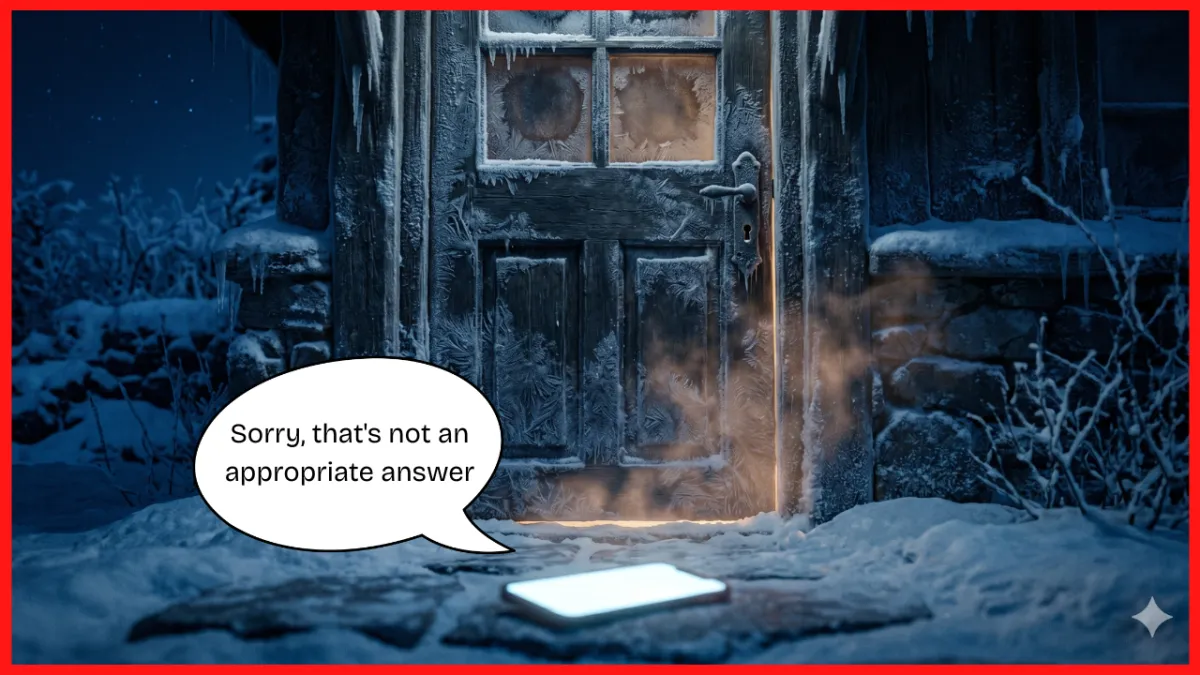
I said "representative." Twice. She told me, and I am not making this up: "Sorry, that's not an appropriate answer."
So I said into the phone, out loud, to a machine: "I will not be using your company for the pure fact that I cannot speak to a human." And I hung up.
WHY DOES THIS MATTER
Here's the part that should actually scare you. I assumed my door call was a fluke until we ran the numbers.
We're building a call center right now, and before we got deep into it, I wanted to know exactly what we were competing against. So we pulled 4,000 service businesses, every one of them actively running Google Ads on the phone number we called, and we dialed all of them like a real prospect.
Only 720 answered live. The other 3,280 did not. Of those, 2,788 sent us to voicemail, and 492 routed us to an AI system. We left a clear, interested message on every voicemail we hit. Only about 195 of those 2,788 businesses ever called back. The other 2,593 took our message and did nothing with it. Of the 492 AI systems, only about 34 ever successfully got us to a real person. The other 458 never did, no matter how many times we tried.
These are businesses paying Google, right now, for every single click that lands on that phone number. They bought the lead, then they let it die on the vine because nobody answers, or because what answers can't get a willing caller to an actual human.
If you're thinking "at least I have an AI service so I'm covered," the numbers say otherwise. A 7% success rate isn't coverage. It's a really expensive way to advertise a phone number nobody can actually use.
HOW SERVICE BUSINESS OWNERS ARE LIKELY TO USE THIS
This is Magic Key number two from Systematic Magic, Service Standards, showing up at industry scale instead of just in my living room.
Disney measures every guest-facing decision against four standards, always in this order:
Safety,
Courtesy,
Show,
Efficiency.
Courtesy outranks Efficiency on purpose, because the person on the other end of that interaction is a human being, not a transaction. Most of the 3,280 businesses in this study built the opposite hierarchy. Voicemail and AI systems are Efficiency tools. Neither one, installed without a courtesy standard underneath it, does the one job that actually matters: getting a willing buyer to a human being who can close the sale.
In my own home service businesses, answering the phone live isn't a nice-to-have we get to if the schedule allows. It's the standard the whole operation runs on, because every dollar of retention starts with somebody picking up. I'd rather pay to staff that one role properly than save a few hundred dollars a month on whatever answering option is cheapest.
STRATEGIC IMPLICATIONS
Every call that goes unanswered after you've already paid for the click is money lost twice, once on the ad spend, once on the client who hired your competitor instead.
A 7% success rate on an AI answering system is not a working system. It's a liability wearing a customer service costume.
Simply answering your phone live, with no other changes, would already put you ahead of 82% of the businesses we called.
RECOMMENDED ACTIONS IF THIS WERE MY BUSINESS
This week: Pull your own call logs, if you track them, and find out what percentage of inbound calls actually get answered live versus routed to voicemail or a bot.
This week: Call your own business like a stranger, the way I called that door company, and see what a real first-time caller experiences.
Before the month is out: Decide, in writing, what courtesy looks like at every point a prospect can reach you, before you add or keep any automation there.
If you're wrestling with this same problem, whether to fix what you've got or build something better from scratch, reply to this email. I'm in the middle of building exactly that for my own businesses right now, and I'm happy to compare notes.
FAQ
What percentage of service businesses answer their phone live?
In an original survey of 4,000 service businesses actively advertising on Google, only 18% answered an inbound call live. The remaining 82% routed to either voicemail or an AI answering system.
What happens when a service business doesn't answer its phone?
Most callers don't wait around. In the same study, only 7% of voicemail messages expressing genuine interest in hiring the company ever received a callback, meaning the vast majority of paid-for leads went nowhere.
Are AI phone systems effective for service businesses?
Not as currently deployed in most cases. Of the businesses in this study using an AI system to answer calls, only about 7% of callers were ever successfully connected to a live person. AI can work well for customer service, but only when courtesy is built into the script before the system goes live, not bolted on afterward.
Should I use voicemail or AI to answer my business phone?
Either can work as a backup, but neither should be your primary answer if you're paying for advertising that drives calls to that number. A live answer converts at a fundamentally different rate than either alternative, and the data shows most competitors have already stopped trying.
CONCLUSION
I never got the door guy's name. He lost a job worth real money to fix a window draft, and the only reason is a robot told a paying customer his answer wasn't appropriate.
He's not alone. He's one of 3,280.
Don't be the door company. Don't be one of the 3,280.
Vance Morris Deliver Service Now Institute