Free Articles To Help You...
Create Extraordinary Experiences
Command Premium Prices
Scale Your Business
Avoid Service Mistakes
Attract More Customers
One Ketchup Packets: How Forgotten Details Quietly Kill Client Loyalty
One Ketchup Packet: How Forgotten Details Quietly Kill Client Loyalty
One-Sentence Summary: Small, overlooked service details such as missing items, skipped follow-ups, and incomplete handoffs damage client retention more reliably than price or product quality, because clients remember the last small thing a business got wrong.
TL;DR BOX
1) TL;DR / Quick Answer
Clients rarely fire you over the big thing. They fire you over the accumulation of small things nobody on your team thought mattered. A missing condiment packet, an unreturned call, a report that arrives without the cover page. Details are not decoration. They are the evidence your client uses to decide whether you are worth premium money.
2) Key Takeaway
If the detail is invisible to you and visible to your client, your client is the only one keeping score. And the scoreboard is the only one that counts.
3) Executive Summary
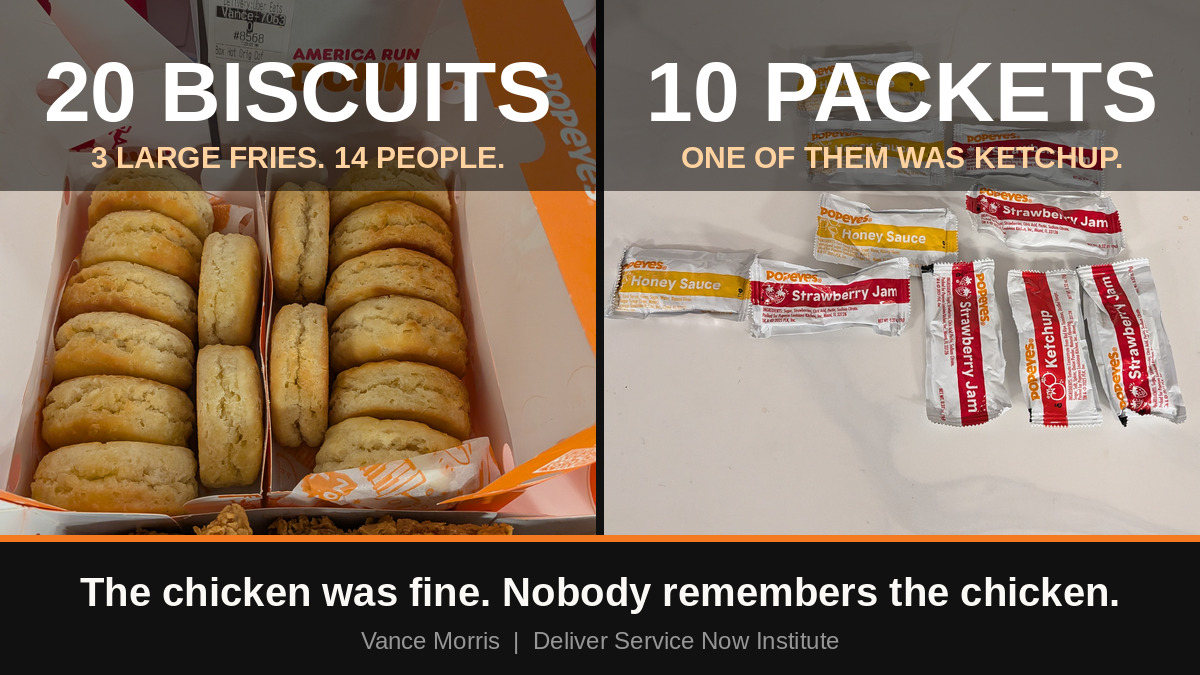
I hosted my Alliance Mastermind for two days with 14 business owners in the room. I ordered Popeyes for lunch. Three large boxes of fries, 20 biscuits, and a condiment allotment that would have insulted a single person eating alone. One ketchup packets. Five jam. Four honey. Somebody in that kitchen made a decision, or failed to make one, and 14 people noticed instantly. I reached out to Popeyes for comment and received silence. That silence is the second failure, and it is the more expensive one. This piece breaks down the Details, Details, Details Magic Key from my book Systematic Magic, why detail failures predict defection better than satisfaction surveys, and the exact audit to run on your own business this week.

4) Quick Facts
Magic Key covered: Details, Details, Details (Key #1 in my book Systematic Magic)
Trigger event: a catered Popeyes order for 14 mastermind members, August 2026
Condiment count delivered: 2 ketchup, 6 jam, 6 honey, against 20 biscuits and 3 large fries
Response from Popeyes corporate as of publication: none
Core principle: detail failures are cheap to fix and brutally expensive to ignore
Applies to: attorneys, financial advisors, accountants, consultants, contractors, and any professional charging above market
5) Key Data
Proprietary data (Vance Morris, Deliver Service Now Institute):
The service system I built for Chef Mickey's at Disney's Contemporary Resort ran more than 700 documented pages. It produced the #1 rated character dining experience in the entire Walt Disney Company for the three-plus years I ran it, along with the highest reservation count and highest revenue of any Disney character restaurant.
I have owned three home service businesses for 19 years. Eastern Shore Carpet Cleaning, Eastern Shore Rug Cleaning, and Maryland Mold Busters. I spend 90 minutes a week on all three combined, because the details are documented instead of remembered.
Detail systems currently running in those businesses: summer crews in Hawaiian shirts who greet with "aloha," and rotating post-service gifts such as grill tool sets during the May and June promotion window.
Alliance Mastermind session size for this event: 14 owners, two days, one catastrophically under-sauced lunch.
External data (cited, not mine):
Sixty-three percent of U.S. consumers reported at least one incorrect food delivery order since 2021. When an order arrives wrong, late, or missing items, 66% blame the restaurant rather than the delivery service. Twenty-four percent have requested a refund, and 20% say they would not order from that restaurant again. Nearly one in five told friends and family not to use the delivery service at all. Source: eduMe survey, reported by Restaurant Dive. Restaurant DiveCSP Daily News
Tom Peters, author of In Search of Excellence, declared that service in America stinks more than 20 years ago. It has gotten worse since.
Somebody Blew It in Packaging
I just wrapped two days with my Alliance Mastermind. Fourteen sharp entrepreneurs in one room for the sole purpose of tearing apart and rebuilding each other's businesses. No fluff, no trust falls, no motivational nonsense about believing in yourself.
Day one, lunch. I ordered Popeyes delivered to the meeting.
Now, before anybody clutches their pearls about the catering budget, that same group sat down that evening to a four-course wine dinner. I feed my people. Lunch was supposed to be fast and greasy and good, which is exactly what Popeyes does well.
The bags arrived. Three big boxes of French fries. Twenty biscuits.
And the condiments.
Two packets of ketchup.
Six packets of strawberry jam.
Six packages of honey.
For fourteen people.
Do the math on that with me. Twenty biscuits, twelve total sweet packets. Three family-size boxes of fries, and two lonely ketchups. Somebody in that kitchen physically counted out honey packets, stopped at six, looked at the pile of biscuits, and decided that was good enough. Or nobody counted anything and the bag got whatever was within arm's reach.
I don't know which is worse. Both answers point to the same problem.
Fourteen business owners, all of whom teach and study customer experience for a living, watched this unfold in real time. You want a room to instantly get the point of a lesson on details? Hand them a biscuit and no honey.
So I did what any reasonable person does. I reached out to Popeyes for comment.
Crickets. Nothing. Not an apology, not a coupon, not a "hey, sorry about that." A brand with thousands of locations, a marketing department, and a social listening team, and my inquiry vanished into the void.
The chicken was fine. The chicken was great, honestly. And the only thing anybody remembers is the ketchup.
Nobody Complains. They Just Stop Coming Back.
Here is what Walt Disney understood that most business owners never internalize.
Walt was famously obsessed with details, and he demanded everybody around him carry the same obsession. Not because he was a perfectionist with control issues, though he probably was. Because he understood that the guest experiences the whole show, and the whole show is made of a thousand tiny pieces, and the guest only notices the pieces that are missing.
John Hench, one of the original Imagineers, watched Walt insist that the pavement change texture and color between the lands at Disneyland. Not the buildings or rides, but the ground. Nobody consciously registers that transition. Everybody feels it.
That is Magic Key #1 from my book Systematic Magic. Details, Details, Details. And it is first in the list for a reason.
Look back at what the outside research says about missing items. Twenty percent of people who receive a wrong order simply never order from that business again. They don't call, post a review or file a complaint you could actually learn from. They quietly delete you from the rotation and you never find out why revenue softened.
That is the mechanism. Detail failures don't produce complaints. They produce silence. Silence is the tell. I wrote about where that silence starts in the sixty seconds after a client says yes, and the pattern is identical. Nobody announces they're leaving. They just stop feeling chosen. And silence looks exactly like satisfaction right up until the renewal date.
Your version of the missing ketchup packet is not fried chicken. It's the quarterly review deck that arrives with last quarter's date on the footer. It's the intake paperwork that asks a client for information they already gave you twice. It's the voicemail greeting that still says "closed for the holiday" on February 12th. It's the follow-up call after a big engagement that nobody made because it wasn't assigned to anybody.
Small. Cheap to fix. Devastating in aggregate.
The Weak Version of You Says It's Not a Big Deal
I know the objection because I hear it in every room I stand in front of.
"Vance, come on. Nobody's leaving me over a typo. My clients hire me for results. They stay because I make them money and win their cases. Condiments at a chicken joint don't map to a professional practice."
Wrong, and expensively wrong.
Your client cannot evaluate your technical work. That is the entire reason they hired you. They do not know if your tax strategy was clever or if your motion was well argued or if your portfolio allocation was smart. They lack the training to judge the thing they are paying you for.
So they judge what they can judge.
Did the office smell like coffee or like a wet dog? Did the person who answered the phone know their name? Did the engagement letter have their company name spelled right? Did the promised document show up when it was promised?
Those are the proxies. Those are the only signals your client has for whether you are competent at the things they cannot see. Get the small visible things wrong and they will assume you are getting the large invisible things wrong too.
Your competition, by the way, is not the other attorney across town. Your client compares you to everyone. The oil change they got that morning. The steakhouse they're going to that night. Amazon, which told them exactly when the box would arrive and then delivered it.
The alternative is grinding your fee down until there's nothing left to defend, which is [how that story always ends]
You are being graded against all of it, constantly.
700 Pages to Serve Mickey Mouse Pancakes
When I built the operation at Chef Mickey's, I brought every single stakeholder into the room. Chefs, servers, bus boys, dishwashers, housekeepers, reservation agents, character managers, interior designers, music directors, entertainment leads.
The bus boys designed table reset packages so tables flipped faster. The music directors selected specific songs engineered to move guests along at the right tempo. The interior designers built furniture that could be moved and cleaned quickly while still looking unmistakably Disney. The reservation agents got scripts written specifically for that restaurant.
Then everybody rehearsed. Practiced. Adjusted. Practiced again.
The final documentation ran past 700 pages. And Chef Mickey's became the #1 rated character dining experience in the entire Walt Disney Company for the three-plus years I ran it, with the highest reservation count and highest revenue of any character restaurant in the company.
Somebody at that Popeyes needed one line on one page. "Two condiment packets per biscuit, four ketchup per large fry, count before sealing." One line. That's it. That's the whole fix.
Closer to home, in my carpet cleaning business, my crews wear Hawaiian shirts all summer and greet clients with "aloha." Ridiculous? Absolutely. Memorable? No carpet cleaner within a hundred miles of me is doing it, and clients bring it up unprompted a year later. Every job also ends with a gift that rotates by season. Grill tool sets in May and June.
None of that is expensive. All of it is documented. And it is a meaningful part of why I now spend 90 minutes a week on three businesses I have owned for 19 years.
Strategic Implications
Detail failures are leading indicators of defection, while satisfaction scores are lagging indicators. By the time the survey comes back low, the client is already interviewing your replacement.
Premium pricing creates premium scrutiny. The more you charge, the smaller the detail a client will notice and hold against you. Raising fees without raising detail standards is how you manufacture churn.
Undocumented details are not standards. They are hopes. If a detail lives only in your head, it dies the day you take a vacation.
The second failure costs more than the first. Popeyes botching the order was a mistake. Popeyes ignoring my outreach was a decision, and it converted an annoyed customer into someone writing an article about them.
Detail systems compound in your favor. Each documented detail is permanent margin, because it never has to be re-decided.
The Condiment Test: a decision framework for what to fix first
Sort every detail failure in your business into one of three tiers before you spend a dollar fixing anything.
Tier 1, Invisible. The client never perceives it. Your internal file naming convention. Fix these last, or never. Perfectionism here is expensive theater.
Tier 2, Irritating. The client notices, sighs, and continues. Repeated intake questions, a slow callback, an unbranded invoice. These do not trigger departure individually. They stack, and the stack is what eventually breaks. Fix these second, in volume.
Tier 3, Fatal. The client notices and it directly contradicts the promise they paid for. A missed deadline after you sold reliability. A generic form letter after you sold personal attention. Two ketchup packets after you sold a meal for fourteen. Fix these first, this week, before anything else on your list.
The sorting rule is simple. Ask whether the detail failure contradicts the specific reason the client chose you. If it does, it's Tier 3, and it is on fire right now.
If This Were My Practice, Here Is What I'd Do Before Friday
Today, order from yourself. Become your own client. Fill out your own intake form. Call your own main line and time the answer. Open your own welcome packet. Write down every single thing that annoys you. Do not fix anything yet. Just write.
Tomorrow, run the walk-through with two employees. Take two people from your team, one veteran and one newer hire, and walk the entire client journey from first call to final invoice. The new hire sees what you have gone blind to. The veteran knows where the shortcuts get taken. Do not defend anything they find.
By midweek, sort everything into the three tiers. Invisible, Irritating, Fatal. Be honest about the Fatal column. Most owners misfile Tier 3 problems as Tier 2 because the truth is uncomfortable.
By Thursday, document one Tier 3 fix as a written standard. Not a conversation. Not a reminder at a team meeting. A written line that says what happens, who does it, and by when. One line beats a hundred good intentions.
By Friday, add one plus. One small, noticeable, inexpensive upgrade that no competitor in your market is doing. Then make noise about it. Tell your clients. Tell your prospects. A detail nobody knows about is a detail that does not get paid for.
Put the audit on the calendar quarterly. Details rot silently. The Hawaiian shirt idea works because it gets checked, refreshed, and replaced before it goes stale.
If you want the exact form Disney uses to make sure the details actually get attended to, along with the instruction guide, it's at VanceMorris.com/GoodShow.
FAQs
Why do clients leave a business they said they were happy with?
Because satisfaction and loyalty are not the same thing. Satisfied clients leave all the time. They accumulate small detail failures, none individually large enough to complain about, until the total makes switching feel easy. The complaint you never receive is the one that ends the relationship.
What is the "Details, Details, Details" Magic Key?
It's Magic Key #1 in my book Systematic Magic, drawn from Walt Disney's obsession with the small elements of the guest experience that nobody consciously notices but everybody feels. In practice it means identifying every touchpoint a client experiences, defining what excellent looks like at each one, documenting it, and enforcing it.
How do small service details actually affect client retention?
Clients cannot evaluate your technical expertise, so they evaluate the things they can see. Small details serve as proxy evidence for your overall competence. Get the visible small things wrong and clients assume the invisible large things are also being handled sloppily.
Do details matter more than price?
For any business charging above market, yes. Price resistance is usually a symptom of an experience gap. When the experience justifies the number, the number stops being the conversation.
How do I find the details my business is getting wrong?
Stop asking your clients and start experiencing your own business. Go through your entire client journey as a customer would. Then repeat the walk-through with a new hire, who has not yet gone blind to the problems everybody else stopped seeing.
How often should I audit the client experience?
Quarterly at minimum. Detail standards decay the moment they stop being checked, and the decay is invisible from the inside.
The Chicken Was Fine
That's the part that should scare you.
The product was good. The chicken was hot, the biscuits were fresh, the fries were solid. Popeyes did the hard part correctly and lost the room on the easy part.
Your work is probably excellent too. That is not what your clients are grading.
Somewhere in your business right now there's a version of two ketchup packets. Something small, something cheap, something that would take one sentence in one document to permanently solve. Your clients have already noticed it. They just aren't going to tell you.
Four Days to Find Yours, at the Grand Floridian
Here's a number from Harvard Business Review. On a five point satisfaction scale, a client who rates you a four is six times more likely to leave you than a client who rates you a five.
Six times. Between "satisfied" and "totally satisfied."
That's why Disney never showed satisfaction scores to cast members. Only the percentage of guests who scored a five. Disney does not measure satisfaction. Disney measures loyalty, because loyalty is the only thing standing between your client list and the competitor who wants it.
The gap between a four and a five is made entirely of details. Ketchup packets. Return calls. The thing your team stopped doing in March and nobody noticed.
October 25 through 28, I'm taking 30 business owners to Disney's Grand Floridian for four days to find every one of those gaps in their own operation and close them.
Four nights at the Grand Floridian. A backstage tour of the Magic Kingdom most guests will never see. A walking classroom at EPCOT. Dinner at California Grill and at Fantasmic. Every meal. Park tickets. And four days of me at a whiteboard building your service blueprint with you in the room, not handing you a workbook and wishing you luck.
You leave with the system, not the notes.
The whole thing is $1,997.
Before you decide that number is a typo, the room alone runs $804 a night at the Grand Floridian this October. Four nights is $3,216. That's a bed and a Victorian roof and nothing else. Total value on everything included is $21,821. I locked that room block for a program that changed shape on me, Disney doesn't refund locked blocks, and I would rather fill those rooms with sharp owners than watch them sit empty. My arithmetic problem is your window.
Thirty rooms. Sixteen still open as of this writing.
Full details at deliverservicenow.com/mtm26.
Go find your ketchup packet before your clients decide to stop ordering.
Vance Morris
Deliver Service Now Institute
The Only Disney Experience Direct Response Marketer on the Planet
P.S. The Disney Institute runs a comparable program for $7,425, and that's before you pay for a hotel and park tickets. Call it $11,625 all in, in a classroom with 50 to 75 people, reading from a script that's been sanitized for public consumption. Mine is $1,997, capped at 30, and nothing gets sanitized. deliverservicenow.com/mtm26
P.P.S. You also get 90 days of coaching calls with me after you get home, plus three months of The XPerience Report. Because the ideas are worthless until they're installed, and most owners lose the whole trip somewhere in the first two weeks back at the office. That doesn't happen on my watch.
Vance Morris
Deliver Service Now Institute